Home  /  Guides
Guide

Bullet Journal Habit Tracker Layouts

Six bullet journal habit tracker designs that actually get used, how to set one up in a dot grid notebook, the supplies you genuinely need — and the printable shortcut for when redrawing it every month gets old.

6Layouts
3–5Habits per spread
4Supplies needed

Written & reviewed by Ahmad Hussain · August 2026

Bujo Grid

Classic layout
MTWTFSS💧 Water✓✓✓✓✓✓📚 Read✓✓✓✓✓🏃 Move✓✓✓✓✓✓
Layouts6 designs
The basics

What a habit tracker bullet journal spread is

A hand-drawn grid in a notebook where you mark off habits as you complete them.

A habit tracker bullet journal spread is part of the wider bullet journal system, but you don't need the rest of that system to benefit from the tracker. A dot grid notebook, a pen and a ruler is the whole requirement.

The appeal is that you draw it yourself, so it fits your notebook, your habits and your handwriting. The drawback is the same thing — you have to draw it, every month, before you can use it. That's the trade-off this guide keeps coming back to.

Layouts

Nine bullet journal habit tracker layouts

Almost every habit tracker bullet journal spread you'll see online is a variation of one of these nine. Each sketch below is drawn on dot grid, at roughly the proportions you'd rule up by hand.

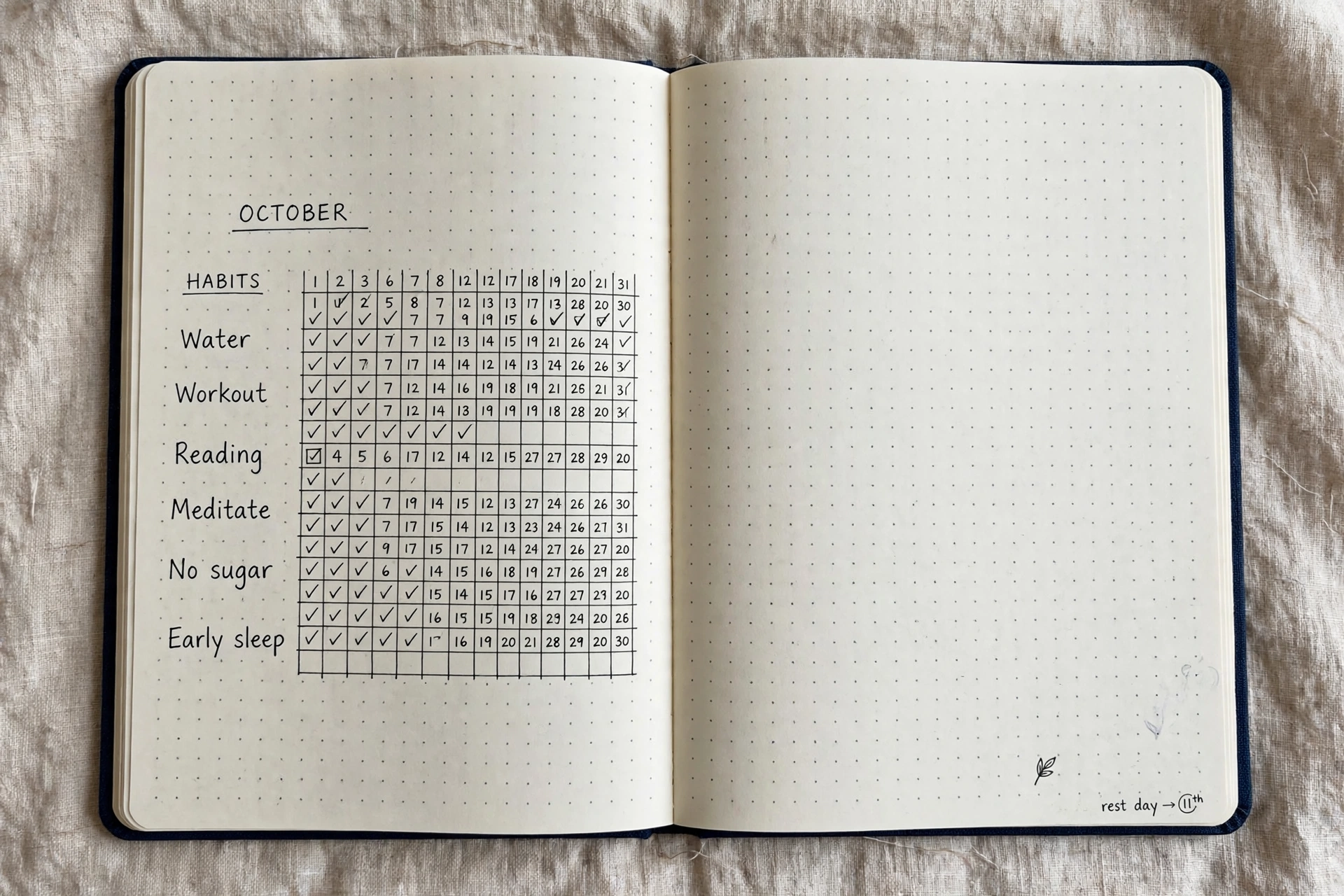
Habit tracker bullet journal layout — minimal hand-drawn monthly spread on dot grid

The classic grid

LAYOUT 01

The classic grid

Habits down the left, days across the top, one box per day. The most readable option and the easiest to rule up with a straight edge. Almost every other layout is a variation of this one.

Best for 3–6 habits

Mini-month calendars

LAYOUT 02

Mini-month calendars

One small month-shaped calendar per habit. Because each habit gets its own calendar, the pattern of misses is obvious in a way the single grid hides — you can see that you always skip Sundays.

Best for 2–4 habits

The circle or mandala

LAYOUT 03

The circle or mandala

Concentric rings, one per habit, each divided into a segment per day. The most shared bullet journal habit tracker on Pinterest, and the slowest to read at a glance. People keep it going because colouring it in is satisfying on its own.

Most decorative

The petal flower

LAYOUT 04

The petal flower

Thirty-one petals around a centre, one coloured in per day. A single-habit tracker rather than a multi-habit one, and it works beautifully as a full-page spread for something you care about.

One habit, one month

The habit chain

LAYOUT 05

The habit chain

One long bar per habit, filled left to right. Breaks in the chain are impossible to miss, which is the point — this layout is for habits where the streak itself is the motivation.

Streak-focused

Year in pixels

LAYOUT 06

Year in pixels

Twelve narrow columns, one per month, with a cell for every day of the year. Drawn once in January and filled in all year. The most ambitious spread here and the most rewarding by December.

Whole year, one page

The honeycomb

LAYOUT 07

The honeycomb

Hexagons tiled across the page, coloured in as you go. No days or dates — just a count. Good for habits you do irregularly, like a long run or a deep clean, where a rigid calendar feels like failure.

Undated

The bookmark strip

LAYOUT 08

The bookmark strip

A narrow vertical column drawn on a cut-down page or a separate strip of card, so it sits in your journal wherever you are. The one layout you'll actually fill in daily, because you don't have to find the spread first.

Most portable

Mood and habits together

LAYOUT 09

Mood and habits together

A mood bar across the top, habit grid underneath, sharing the same day columns. After a month you can see which habits you keep on bad days and which collapse — genuinely the most useful spread on this list.

Best for insight
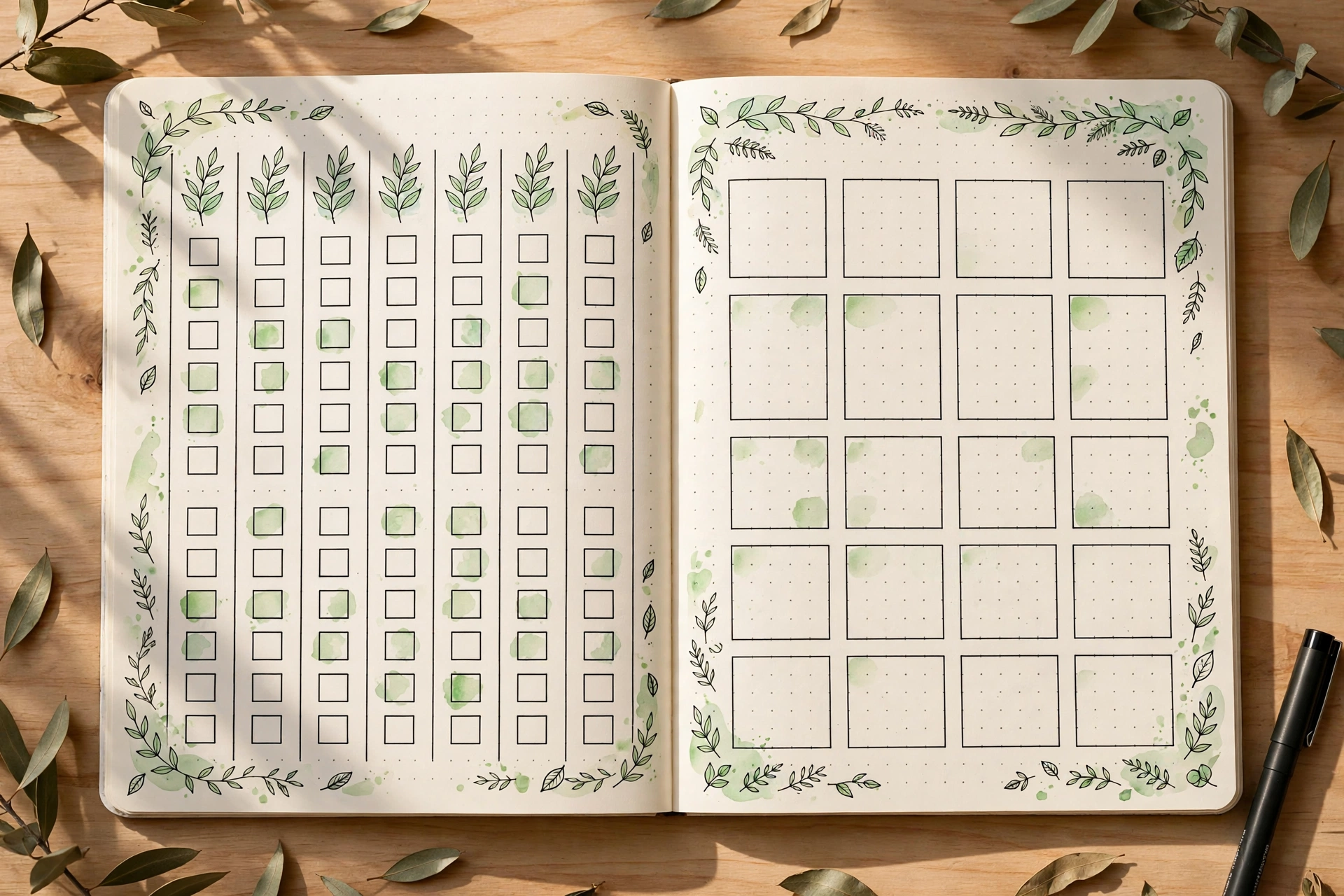
Bullet journal habit tracker — creative botanical weekly spread
What to track

40 things to track in a habit tracker

The layout matters less than what goes on the rows. These all pass the one test that counts: at the end of the day you can answer yes or no without having to think about it.

Body

  • Drink 2 litres of water
  • Move for 20 minutes
  • 10,000 steps
  • Stretch before bed
  • Lights out by 11
  • No sugar
  • Took vitamins
  • Ate a vegetable

Mind

  • Read 10 pages
  • Ten minutes quiet
  • Wrote something
  • Learned a new word
  • No phone for the first hour
  • Journalled
  • Practised an instrument
  • Studied 30 minutes

Home and money

  • Made the bed
  • Washed up before bed
  • Ten-minute tidy
  • No spending today
  • Logged what I spent
  • Cooked instead of ordering
  • Watered the plants
  • Inbox to zero

People and self

  • Called someone
  • Said thank you properly
  • Time outdoors
  • Skincare
  • No doom scrolling
  • Asked for help
  • Ate a meal with someone
  • Went to bed on purpose

Weekly rather than daily

  • Long run or long walk
  • Deep clean one room
  • Reviewed the week
  • Planned next week
  • Batch cooked
  • Backed up my files
  • One thing I'd been avoiding
  • A day with no screens

If you want the longer version of this, 50 habits to track goes through each category properly and explains which ones tend to survive past the second week.

By hand

How to draw a habit tracker without a stencil

The classic grid, in eight steps, using nothing but the dots already printed on the page. No ruler tricks, no stencil, no washi tape required.

  1. Count your dots first. A standard A5 dot grid page is 5 mm spaced, giving roughly 38 columns by 53 rows of usable space. Count once and you never have to measure again.
  2. Decide your habits before you draw anything. Three to six. Write them on scrap paper first — renaming a row after you've inked the grid is how spreads get abandoned.
  3. Leave the left third for labels. About 12 dots wide is enough for "Drink water" in normal handwriting. Mark the dot where your labels end and your grid begins.
  4. Give each day one dot of width. For 31 days you need 31 columns, which fits across a single A5 page with the label column. If it feels cramped, use a two-page spread and put days 1–16 on the left.
  5. Give each habit two dots of height. One dot is too tight to mark cleanly; two gives you a square you can tick, fill or colour.
  6. Draw the outer box first, then the divider. One line around the whole grid, one vertical line where the labels end, one horizontal line under the day numbers. Those three lines carry the whole spread.
  7. Rule the inner lines last, lightly. Pencil or a fine 0.3 pen. The inner grid is a guide, not the design — heavy inner lines make the spread look like a spreadsheet.
  8. Number the days, then stop. Resist decorating it until you've used it for a week. Most abandoned spreads were decorated before they were tested.

If eight steps sounds like more effort than the habit itself, that's a reasonable conclusion — and it's what the printable habit tracker templates are for. Print one, trim it, glue it into the spread, and you get the same result in about a minute.

Setup

How to set up a bullet journal habit tracker

Six steps to set up a bullet journal habit tracker, in order. Do them before the month starts.

🔢

Count your habits first

This decides everything else. Three to five is the practical maximum for a hand-drawn month.

📏

Count your notebook's squares

A standard A5 dot grid gives roughly 31–38 columns across a spread — enough for a month at one square per day.

✏

Pencil first, pen second

Draw the frame in pencil, check the spacing, then go over it in fineliner. Erase the guides afterwards.

Setup notes

Three things people get wrong

Habit names too long

Keep them to one or two words — "Water", "Read", "Move" — or the left column eats your grid.

A new colour scheme every month

Pick one colour per habit and keep it consistent, so you can compare months at a glance.

No key

If you're using symbols rather than colours, leave a small key in the corner or you'll forget by week three.

Setting it up on the 4th

Drawing next month's tracker after the month starts means you've already lost days. Do it in advance.

Supplies

What you actually need

You need very little to start a bullet journal habit tracker. The elaborate supply lists you see online are a hobby in themselves — this is the real list.

📗 A dot grid notebook🖊 One fineliner✏ Pencil and eraser📏 A short ruler🎨 Two or three coloured pens❌ Not fifteen highlighters
Put it to work

The printable shortcut

Print the grid, decorate by hand

Keep the creative part — colours, doodles, headers, washi tape — and skip the ruler work. Print at notebook size and glue it in.

Open the habit tracker →

The honest comparison

Printable vs hand-drawn

Both work. They fail for different reasons.

Hand-drawing is enjoyable and fully customisable. It's also the most common reason a bullet journal habit tracker gets abandoned: at the end of a busy month, redrawing the whole grid is a chore, so it doesn't get done, and the habit quietly goes with it.

The middle path a lot of people land on is printing the grid and decorating it by hand. You keep the part that's fun and skip the part that's admin. Print it at the size of your notebook page and glue or tape it in.

It also means a missed month costs you nothing. You print a fresh sheet in seconds instead of facing an hour of setup you don't have time for.
Questions

Bullet journal habit tracker FAQs

How many habits fit on one bujo spread?+

Three to five for a hand-drawn bullet journal habit tracker. Past that the boxes get too small to fill in comfortably and the setup takes longer than most people will keep doing.

What size notebook is best?+

A5 dot grid is the standard for a reason — it gives roughly 31–38 columns across a two-page spread, which is exactly a month at one square per day.

Can I print a bullet journal habit tracker and stick it in?+

Yes, and it's a common setup. Print at your notebook's page size, trim, then glue or tape it in and decorate around it.

What if I mess up the grid?+

Leave it. A visibly imperfect bullet journal habit tracker you keep using beats a perfect one you redraw three times and then abandon.

Should I track mood alongside habits?+

You can, and it's useful for spotting patterns over a month. Just remember it shows correlation, not cause.

Next

Where to go from here

For choosing what goes in the rows, see the 50 habits to track list — seven categories and the rule for picking habits you'll actually tick.

For picking the grid size, daily vs weekly vs monthly compares the three layouts. And how to build a habit covers what to do when a streak breaks — which matters more than the design of the sheet.

Your streak starts on paper

Make a free printable habit tracker in about a minute.

Open the habit tracker →
> © TrackTheHabit. All rights reserved. Built by Ahmad Hussain.
Scroll to Top